


Most “portable” table saws ask you to make peace with a flimsy fence, a stand that fights you, and a motor that bogs the second you feed it anything thicker than a 1×4. We’ve spent enough time hauling saws in and out of trucks and wedging them into garage corners to be skeptical of the whole category. The DEWALT DWE7491RS is the one we keep coming back to anyway.
At around $649, it sits at the top of the jobsite class, and it isn’t trying to be a cabinet saw. What it does do is rip plywood, break down sheet goods, and handle most hardwood without making you feel like you bought down. We’ve run it on our bench and on site, and below is where it shines, plus the few places it runs out of road. Nothing here is a dealbreaker, but you should know about them before the box shows up.
 View on Amazon
Performance & Power
The 15-amp motor spinning a 10-inch blade at 4,800 RPM is the part that genuinely surprised us. On paper that spec is unremarkable; in use it holds speed better than a saw this size has any right to. We’ve fed it long rips in maple and poplar and it kept the blade turning without that telltale dip in pitch that means you’re about to stall. Owners who use these hard back that up: people report ripping hundreds of cuts through pressure-treated lumber and decking in a day without the motor giving up.
The 3-1/8-inch depth of cut at 90 degrees means you can stand 4×4 stock on edge and get through it, and the 2-1/4-inch cut at 45 covers most bevel work you’ll throw at a saw like this. Where you’ll feel the limit is thick, dense hardwood ripped slowly — push too fast in 8/4 oak and it’ll let you know. That’s physics on a 15-amp universal motor, not a flaw, but it’s worth setting expectations: this is a saw that breaks down material efficiently, not one that whisper-rips slabs all afternoon.
The Fence System
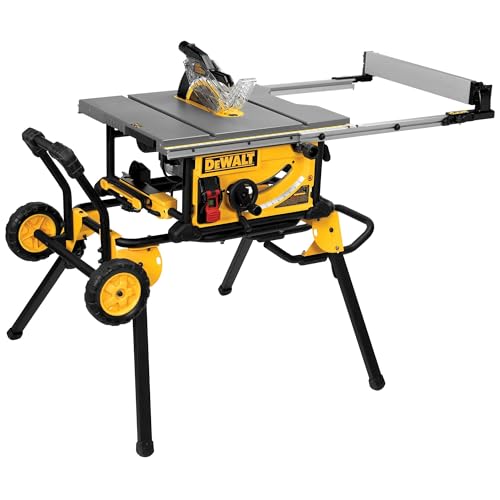
The rack-and-pinion telescoping fence is the marquee feature, and it deserves the attention. Crank the knob and both ends of the fence move together and stay parallel — no tap-tap-measure-tap dance to get it square to the blade. The 32-1/2-inch rip capacity to the right of the blade is the real story for sheet-goods work: you can rip a full 4×8 panel down the middle in one pass instead of measuring from the far edge and praying. For breaking down plywood, that capacity alone justifies a lot of the price.
Now the honest part. The fence is excellent, but it is not magic, and there’s a learning curve people don’t warn you about. Rack-and-pinion designs have a little backlash, which means the fence can land a hair differently depending on which direction you cranked it. The fix that experienced owners land on — and that we use — is to always make your final adjustment moving the fence in the same direction (toward the blade), and to dial in your micro-setting that way every time. Do that and it’s repeatable. Fight it and you’ll chase a thirty-second between cuts.
Two more fence notes from long-term owners worth taking seriously. First, the pinion mechanism can get stiff over time if grit works into the rails — a wipe-down and the occasional dry lubricant keeps the knob turning freely; ignore it and the crank gets genuinely hard to twist. Second, a meaningful number of units benefit from a tension tweak on the fence lock out of the box. None of this is hard, but plan on twenty minutes of setup rather than unbox-and-rip.
Out-of-the-Box Calibration
This is the one we want to be straight about because it’s the most common real complaint. Some units arrive dialed in; others need the blade aligned to the miter slots and the fence squared before you trust a cut. A few owners report a frustrating version where the blade alignment seems to drift back after re-squaring — that’s a minority experience, but it’s real, and it usually traces to the trunnion bolts not being snugged down after adjustment rather than a defective saw.
Our advice: treat the first hour as commissioning, not woodworking. Check blade-to-slot parallelism, square the fence to the blade, set your 90 and 45 stops, and snug everything. Once a DWE7491RS is properly set up, it’s a different tool than the one some frustrated first-day reviewers describe. If you’ve never tuned a table saw, budget time to watch one good calibration walkthrough — it’s a skill that pays off on every saw you’ll ever own.
 View on Amazon
Portability & Setup
The rolling stand is the reason this model exists and the reason we recommend it over the bare-stand versions. The saw weighs about 110 pounds, which is not light — lifting it onto the folded stand the first time is a two-hand, mind-your-back affair. But once it’s on the stand, the eight-inch wheels turn that weight into a non-issue. We’ve wheeled it over thresholds, gravel, and a cracked driveway without drama, and one person can move it from truck to work area without a helper.
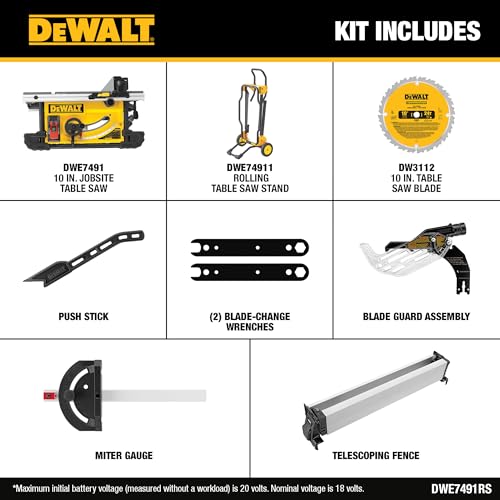
Setup and teardown are genuinely fast. Pop the stand open, lock the legs, and you’re cutting in a couple of minutes; fold it back down and the whole thing tucks against a wall. Onboard storage holds the push stick, blade wrenches, miter gauge, and guard so you’re not hunting for parts on a job. For anyone who shares a garage with a car, or who actually carries a saw to job sites, the stand is the feature that makes the rest of the saw usable day to day.
Dust Collection
The 2-1/2-inch dust port at the rear does its job. Hooked to a shop vac, it pulls roughly 80 percent of the dust generated below the table, which is about as good as it gets in this class. For garage use where you care about your lungs and your floor, that primary port plus a vac is the setup to run.
The second port, on the blade guard above the table, is where DEWALT left some convenience on the table. Capturing the dust thrown above the cut is a nice idea, but connecting both ports at once is fiddly — the common 2-1/2-to-1-1/4-inch Y-splitters aren’t easy to source, and if the upper hose doesn’t fall cleanly out of the way it gets in the path of your workpiece. Most owners we’ve seen, ourselves included, run the main port to a vac and skip the upper one for general work. It’s a missed opportunity rather than a real failing, but don’t buy this expecting clean overhead collection out of the box.
The Accessories
The included 24-tooth carbide blade is a perfectly fine ripping blade and exactly what you want for breaking down lumber and sheet goods — it is not a finish blade, so if you want clean crosscuts in plywood without tear-out, budget for a higher-tooth-count blade. The push stick, two blade wrenches, rip fence, and guard are all solid. The flip-over fence feature for narrow rips is a genuinely smart touch that keeps your hands away from the blade on thin stock.
The miter gauge is the weak link. It works, but it’s basic, and anyone doing repeatable crosscuts or angle work will outgrow it quickly. We consider an aftermarket miter gauge or a crosscut sled an early upgrade, not an optional one, for shop work.
 View on Amazon
Who It’s For
The DWE7491RS is the right saw for the remodeler, the trim carpenter, the deck builder, and the serious DIYer or hobbyist who needs to break down sheet goods and rip lumber without dedicating a garage bay to a stationary machine. The combination of real rip capacity, a fence you can trust once it’s tuned, and a stand that actually rolls is hard to beat at this size. The three-year warranty backs it up.
Who should look elsewhere? Fine-furniture makers chasing glass-smooth, dead-repeatable rips in thick hardwood all day — that’s cabinet-saw territory, where a heavier table, a beefier induction motor, and zero fence backlash matter more than portability. If your saw lives in one spot and never moves, the money is better spent on a stationary contractor or hybrid saw with a cast-iron top. But if you need one saw that goes where the work is and still does honest shop duty when it’s home, this is the one we’d put our own money on.